Jeff Gordon will start from the pole position in Sunday’s NASCAR Sprint Cup race at Martinsville Speedway after steady rain washed out qualifying Friday.
Being the points leader also earned Gordon the prime stall on the cramped pit road of NASCAR’s tricky, 0.526-mile oval. He will be seeking his eighth victory at Martinsville, tops among active drivers, and his first in 47 races.
The qualifying rainout, he figures, only helps his chances.
“I think because of the pit road situation here, this is probably the most important place to start on the pole because you get that No. 1 pit stall,†said Gordon, who has … Details
NASCAR is no different than the corporate world. Prime parking is a sure sign of success.
Tony Stewart has won two races on NASCAR’s shortest, trickiest oval, but when the first-year team owner pulled into Martinsville Speedway on Friday, the place where he saw his team’s hauler parked meant more to him than it probably ever had.
It was, he said, “a proud moment,†and one earned on the track by his seventh-place position in the points standings with a new team that needed to start with some success…. Details
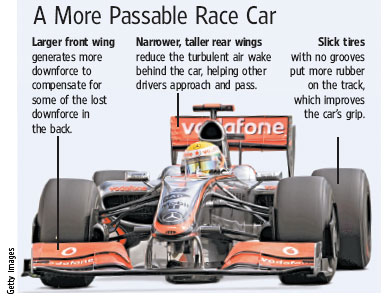 The iconic wings fixed to the back of Formula One cars made them look as sexy and fast as fighter jets. It turns out they were also making the races a bit of a snooze.
The wings were designed to catch the wind and thereby increase downforce on the tires. Downforce helps the tires grip the pavement, which allows the cars to take tight corners without skidding out. But the wings also had a serious side effect: They created a wake of air so turbulent that any car following behind lost up to 33% of its downforce. As a result, cars in F1 had to slow down before sharp turns to stay out of the turbulence created by the car in front — which made it very hard for F1 drivers to pass each other. Nascar, by comparison, has an average of 3,000 changes of position every race.
In 2005, a survey conducted by F1’s governing body found that 94% of fans wanted …Â Details
When it comes to electric vehicles, the Tesla Roadster and Chevrolet Volt get all the love. But there are other EVs rolling around, and they’re balancing on two wheels.
Since 2007, when Vectrix of Middletown, R.I., first rode onto the scene with its battery-powered Maxi Scooter, a growing number of U.S. startups have entered the plug-in two-wheeler market. They’ve invested millions of dollars in vehicles, many of which are poised for production within a year.
Led by pioneers with impressive resumes, these companies predict growth despite the down economy, and they’re laying claim to niche markets with such boasts as “first” and “fastest” as they stake out territory in what many believe is the future of transportation…. Details